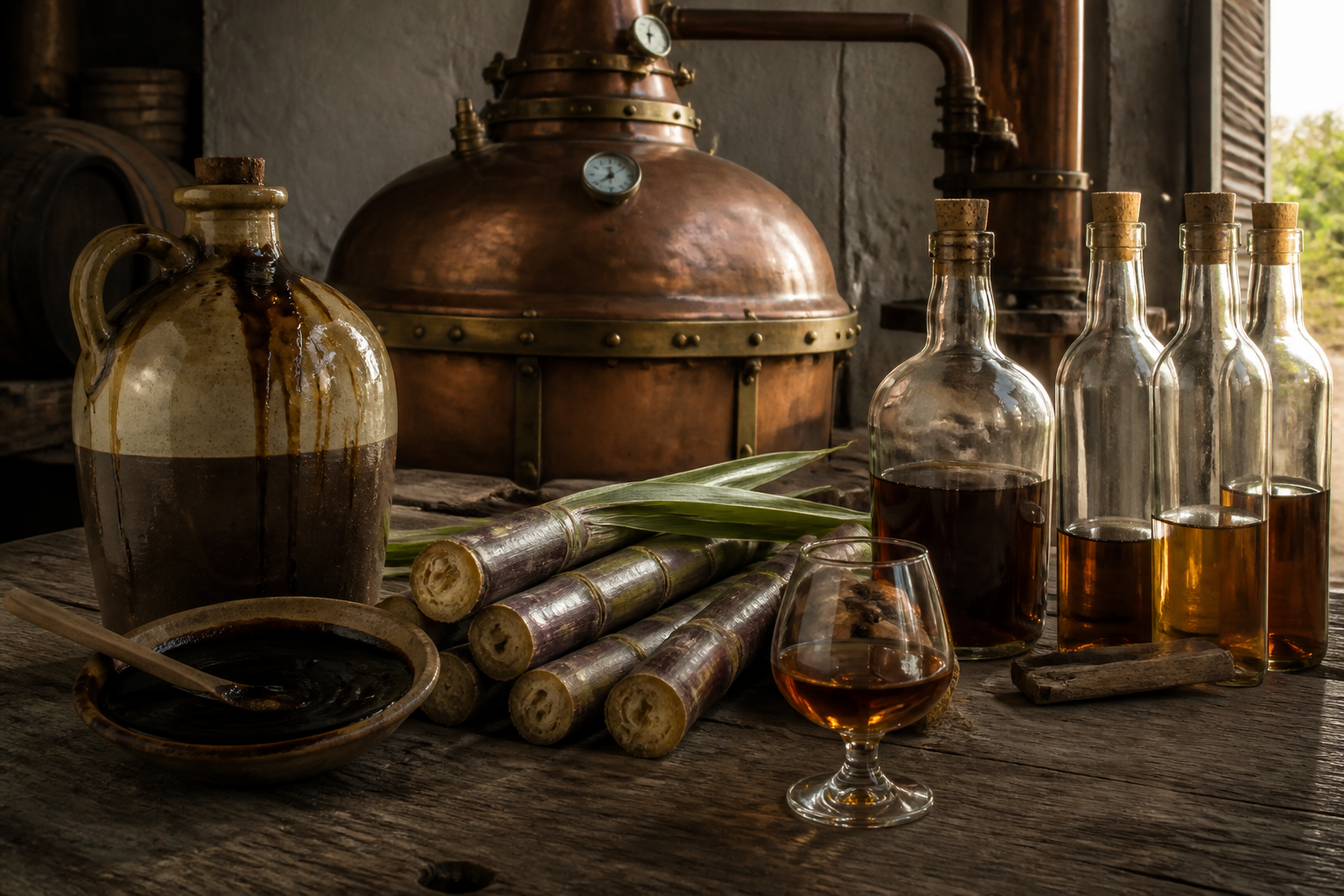
Rum is distilled from sugarcane. That is the only rule every rum-producing country agrees on. There is no international standard for age, additives, or style, so rum has the widest quality range of any major spirit and the least reliable labels. It is also the base of the entire tiki canon and the simplest cocktail in the book.
Back to the liquor primers.
How it is made
Start from cane, one of two ways. Most rum is made from molasses, the thick residue left after sucrose is crystallised out of cane juice. Molasses is stable, shippable, cheap, and still full of fermentable sugar. The other path is fresh-pressed cane juice, which has to be fermented within hours of the harvest because it spoils. Juice-based rum tastes grassy and vegetal. Molasses-based rum tastes darker, of dried fruit and baking spice.
Ferment. Cane sugar needs no cooking or malting, so fermentation starts immediately. Length is the big variable. A 24-hour fermentation with cultured yeast yields a clean wash. A week or more with wild yeast and bacteria — sometimes with dunder, the residue from the last distillation — builds heavy fruity compounds called esters. That is where Jamaican rum’s banana-and-pineapple “funk” is made. It happens in the fermenter, not the barrel.
Distill. Pot stills keep the esters and give a thick, loud spirit. Column stills strip them out and give a light, clean one. Many rums are a blend of both. In the US, rum must be distilled below 190 proof and bottled at no less than 80 proof.
Age, or don’t. Rum needs no aging at all. When it is aged, it is usually in ex-bourbon barrels, in the tropics. Heat accelerates everything: a Caribbean warehouse can lose 6–10% of a barrel per year against roughly 2% in Scotland. A tropical six-year-old has had more wood contact than a Scottish twelve. This is why cross-category age comparisons do not work.
Blend and finish. Nearly all rum on a shelf is a blend of ages and still types. This step is also where sugar, glycerin, and caramel colour get added in many jurisdictions, without disclosure.
Regional styles
The traditional shorthand is by colonial heritage, because that determined the still and the palate.
| Style | Typical origin | Base | Still | Tastes like |
|---|---|---|---|---|
| Spanish-heritage light | Cuba, Puerto Rico, Dominican Republic | Molasses | Column | Clean, dry, faint vanilla |
| English-heritage heavy | Jamaica, Barbados, Guyana | Molasses | Pot, or pot-column blend | Ripe banana, brown sugar, oily |
| Rhum agricole | Martinique, Guadeloupe, Haiti | Fresh cane juice | Creole column | Grassy, olive, mineral |
| Cachaça | Brazil | Fresh cane juice | Column or pot | Green, funky, sometimes native-wood aged |
| Demerara | Guyana | Molasses | Wooden pot and coffey stills | Smoky, char, dark toffee |
| Overproof | Jamaica, Guyana, Trinidad | Molasses | Either | Intense; a float or a flame, not a base |
Agricole versus molasses is the biggest single difference in rum. Martinique’s AOC, in force since 1996, sets the rules for rhum agricole there: fresh juice only, defined cane varieties, distillation on a Creole column, and a minimum bottling strength of 40% ABV. It is the closest thing rum has to a Scotch-style regulation.
Cachaça is legally its own Brazilian category — cane juice, distilled to no more than 54% ABV, bottled between 38% and 48%. Some is rested in native Brazilian woods, which give flavors oak does not.
Colour words carry no weight. “Gold,” “dark,” “black,” and “spiced” are marketing. A dark rum can be a light column rum plus caramel colour. A white rum can be aged rum filtered clear.
What “quality” means here
Added sugar is the central issue. Many producing countries allow sugar, glycerin, sherry, and caramel to be added after distillation with no disclosure, at levels that can exceed 20 grams per litre. Added sugar reads as smoothness, and it is why a widely sold “aged” rum can taste rounder than a genuinely older one. Independent hydrometer testing by rum enthusiasts is how most of this became public; it is not on labels. Producers who add nothing tend to say so directly.
Age statements mean less than in whiskey. Without a governing rule, a number on a rum bottle can mean the youngest rum in the blend, the average age, the oldest component, or the age of the solera system rather than the liquid. Where an age is verifiable, it will be stated plainly — “minimum 8 years,” or a distillation and bottling year.
Still type, stated. A rum that tells you it is pot-still, or gives a pot-to-column blend ratio, is a rum whose producer expects you to care. Jamaican distilleries also publish ester levels in grams per hectolitre of pure alcohol, which is the most literal spec in all of spirits.
Proof. 40% ABV is the floor. 43%, 46%, and cask strength survive dilution better in a shaken drink. Navy-strength and overproof bottlings sit above 50% and are meant to be dosed, not poured freely.
What does not indicate quality. Colour, a pirate on the label, “extra añejo” or “XO” borrowed from other categories, and “solera” used without an explanation of the system. Spiced rum is a flavored product; judge it as one.
Where it goes in a drink
The Daiquiri — 2 oz white rum, 1 oz lime, ¾ oz simple syrup — is the reference test. Three ingredients, nothing to hide behind. If a rum tastes thin or cloying there, it will in everything else too.
Tiki drinks blend rums on purpose: a light column rum to carry citrus, a heavy pot-still rum for the finish, and often an overproof float on top. The rooms in this metro that treat rum as the point of the bar are in the tiki guide — including Strong Water Tavern at Universal, which keeps a rum specialist on the floor.
One tool matters more for rum drinks than any other: crushed ice. A canvas Lewis bag and mallet produce dry crushed ice a blender cannot. Tool and glassware searches are on Shop; the six-tool set is the bar-tool kit. We link tools and glass, not bottles.
Notes
US labeling requirements for rum come from 27 CFR Part 5. Agricole rules cited are those of the Appellation d’Origine Contrôlée Martinique. Cachaça limits are set by Brazilian federal decree. Where this page says a practice is unregulated, that reflects the absence of a binding standard rather than an absence of custom.