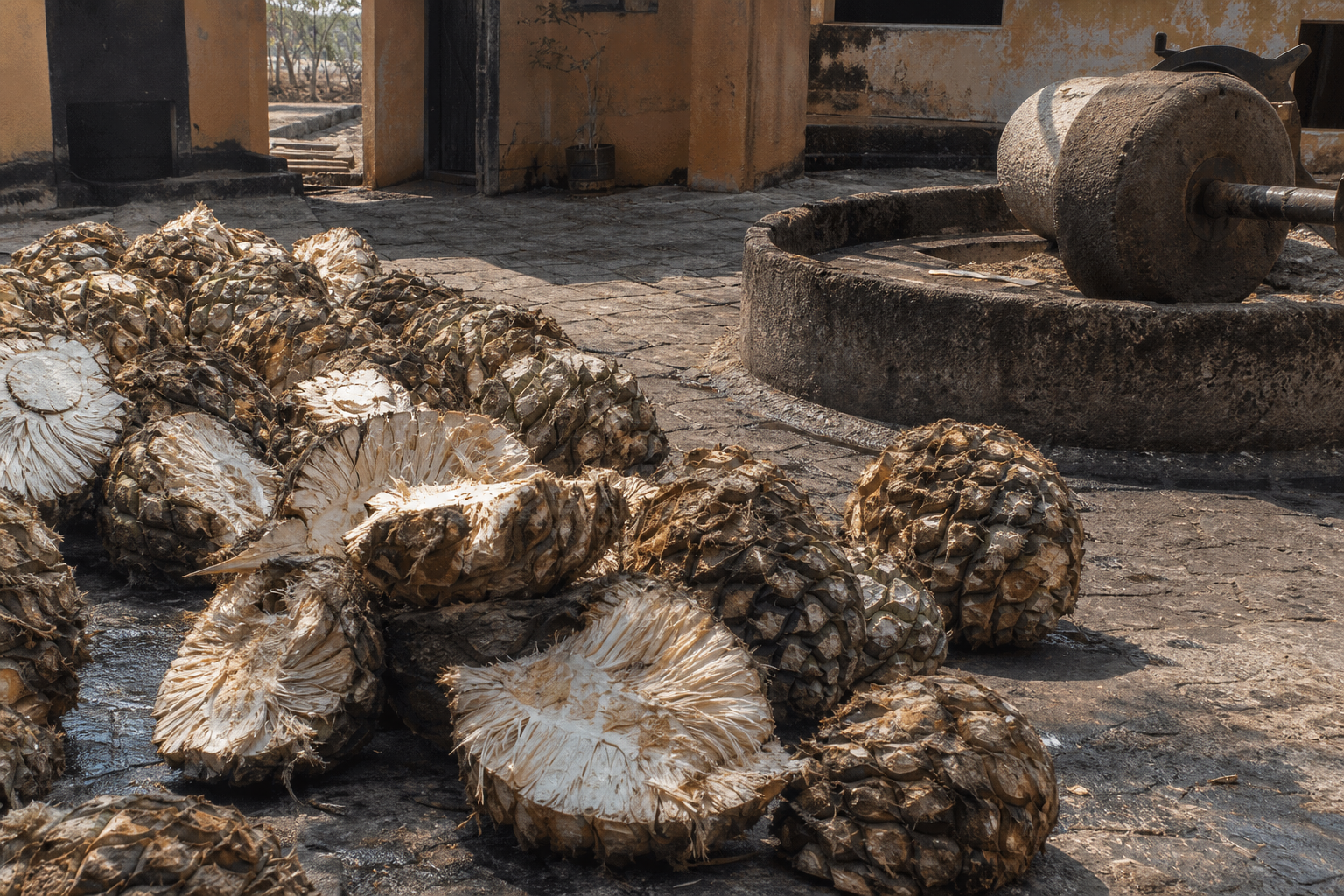
Tequila is distilled from one plant — blue Weber agave — grown and processed inside a defined region of Mexico. It is the most tightly regulated spirit on this list, with a government standard, a regulatory council, and a distillery number printed on every bottle. It is also the category where the label rewards careful reading most, because two bottles of “tequila” can be made in genuinely different ways.

Back to the liquor primers.

How it is made

Grow and harvest. Blue Weber agave takes roughly six to eight years to mature. A jimador cuts away the leaves with a coa, leaving the core — the piña — which weighs somewhere between 40 and 200 pounds. Unlike grain or cane, this is a once-per-plant harvest, and that is the main reason good tequila costs what it does.

Cook. Agave stores its sugar as inulin, a carbohydrate yeast cannot ferment, so the piñas must be cooked to convert it. Three methods, and they matter. Brick ovens (hornos) cook slowly over 24–48 hours and develop caramelised, baked-agave sweetness. Autoclaves are stainless pressure cookers, faster, cleaner, and now the industry norm. A diffuser skips traditional cooking altogether: it shreds raw agave and washes the sugars out with hot water and often acid, then cooks the extracted syrup. Diffusers maximise yield and minimise agave character.

Mill. The cooked agave is crushed to free the juice. A roller mill is standard. A tahona — a stone wheel, historically pulled in a circle — is slow and labor-intensive, and leaves more fiber in the ferment, which some distilleries want for texture.

Ferment and distill. Yeast converts the sugars over two to five days; some producers ferment with the agave fiber still in the tank. Then two distillations, usually in small pot stills. Twice is the standard; a third run strips agave flavor.

Rest. Aging is optional, and how long it rests is what determines the class name on the front label.

100% agave versus mixto

This is the first thing to look for and it takes two seconds. A bottle that says 100% agave (or 100% de agave) was fermented from agave sugars alone. A bottle that says only “tequila” is a mixto: the standard permits up to 49% of the fermentable sugars to come from other sources, normally cane or corn syrup. Mixto is legal tequila. It is also where most of the harsh, hangover-forward reputation of the category comes from.

There is no “100% agave” claim to make on a mixto, so its absence is the tell.

The four classes

ClassTime in oakColourTastes likeUse it for
Blanco / plataNone, or under 2 monthsClearCooked agave, pepper, citrus, mineralMargaritas, anything with lime
Reposado2 months to 1 yearPale strawAgave plus light vanilla and oakSipping, or a rounder Margarita
Añejo1 to 3 yearsAmberOak leads; caramel, spiceSipping, or an agave Old Fashioned
Extra añejoOver 3 yearsDeep amberMostly barrel; agave recedesSipping only

Barrels are capped at 600 litres, and most producers use ex-bourbon casks. Note what the ladder does: more oak means less agave. If you like tequila because it tastes like agave, blanco is not the beginner rung — it is the most honest expression of the category. Añejo is the one that tastes most like whiskey, which is a different pleasure, not a higher one.

Cristalino is a fifth thing you will see. It is an aged tequila filtered to strip the colour out, sold at aged prices with the appearance of a blanco. The filtration removes some of what the barrel added. Treat it as a style, not a grade.

Where mezcal fits

Tequila is a subset of mezcal in the historical sense, but they are separate legal categories now. Mezcal may be made from dozens of agave species, across Oaxaca and eight other Mexican states. The signature difference is the cook: piñas are roasted in earthen pits over hot rocks and wood, which is where mezcal’s smoke comes from. It is a production artifact, like peat in Scotch, not an added flavor.

Mezcal also has finer sub-classes. Artesanal and ancestral designations restrict the equipment — clay pot stills and stone milling at the ancestral end — and are more informative than anything on a tequila label.

What “quality” means here

100% agave. Non-negotiable. Everything else is secondary to this line.

Additives, and the 1% rule. The standard permits four additives — caramel colour, oak extract, glycerin, and sugar-based syrup — up to 1% of the product by weight, with no disclosure required. One percent sounds trivial. Glycerin at that level noticeably changes mouthfeel, and vanilla-forward oak extract can imitate years of barrel time. There is no legal “additive-free” designation; verification programs that exist are third-party and voluntary. A producer who has been verified will usually say which program.

How it was cooked. Brick oven or autoclave beats diffuser for agave character. Diffuser use is not on labels, so this is one you research by distillery rather than read.

The NOM number. Every bottle carries a four-digit NOM identifying the distillery that made it. It identifies the facility, not the brand — many brands share one NOM. It is the single most useful number on the bottle for figuring out what you are actually drinking.

Proof. The standard allows 35% to 55% ABV, and the US market is dominated by 40%. Bottlings at 43%–46% carry more agave and survive dilution better in a shaken drink.

What does not indicate quality. A hand-blown bottle, a celebrity name, “reserva” or “selección” with no defined meaning, and the price of an extra añejo. Also: tequila does not have a worm. That is a novelty practice associated with some mezcal bottlings, and it is a marketing device.

Where it goes in a drink

The Margarita — 2 oz blanco, 1 oz fresh lime, ¾ oz orange liqueur — is the whole argument for buying blanco. Fresh lime is not optional here; bottled juice is why bad Margaritas taste the way they do. Use a citrus reamer, a jigger, and a rocks glass, and salt only half the rim so you can choose per sip.

Locally, Reyes Mezcaleria downtown is the agave-focused room in this directory. The operator menu posts weekdays 5–7 with named $10 pours — hours and how to read the stamp are in how to read a deal.

Tool and glassware searches are on Shopcitrus juicers, jiggers, tins. We link tools and glass, not bottles.

Notes

Class definitions, the 100%-agave and mixto rules, permitted additives, barrel size, and ABV range follow Mexico’s official tequila standard NOM-006-SCFI, administered by the Consejo Regulador del Tequila. Mezcal categories follow NOM-070. Additive limits are legal maximums; disclosure is not required, so this page describes what is permitted rather than what any producer does.