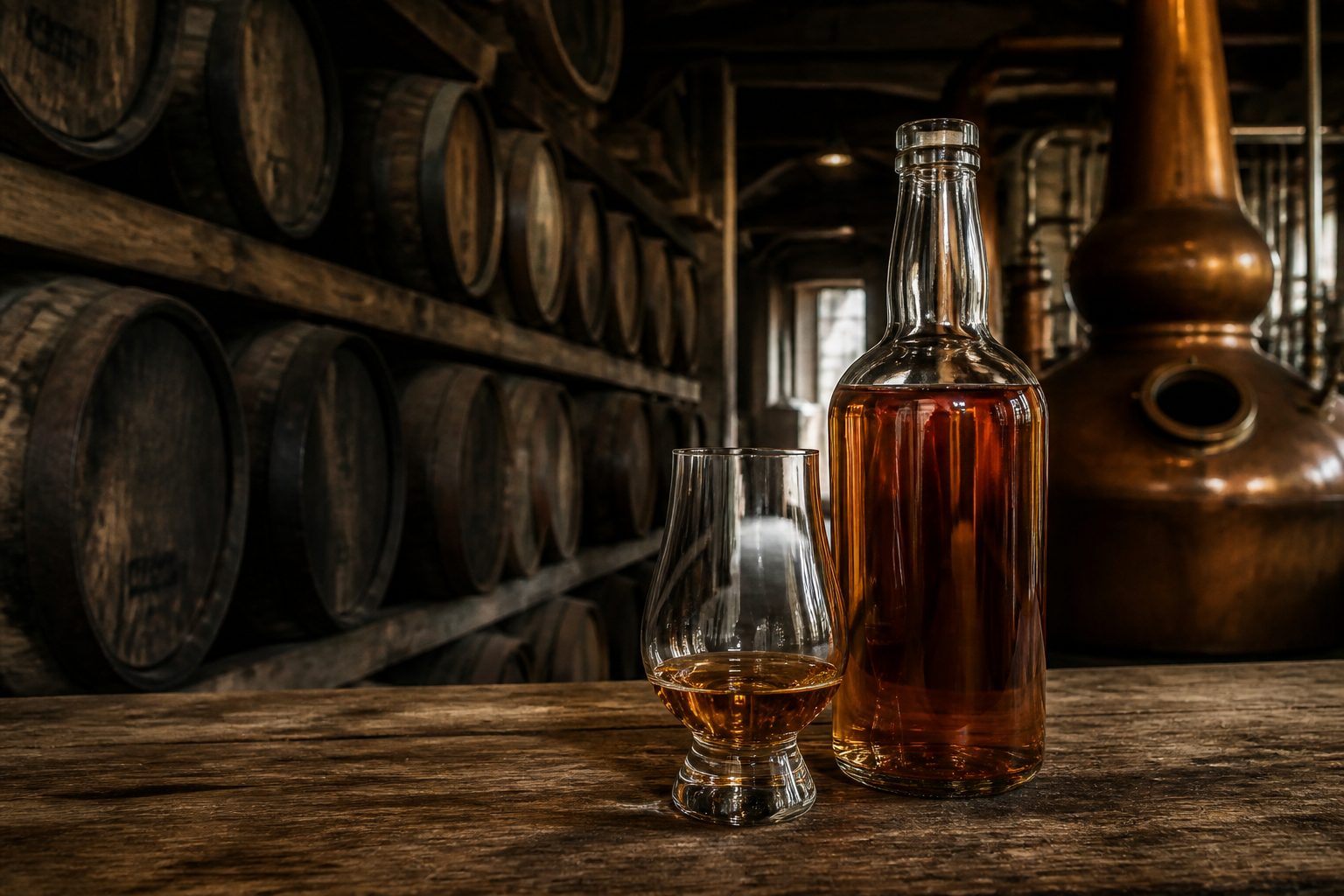
Whiskey is fermented grain, distilled, and aged in oak. That is the entire category. Everything on a label past that word — bourbon, rye, single malt, straight, bottled-in-bond — is a rule about which grain, which barrel, and how long. The rules are unusually strict here, which makes whiskey the easiest spirit to read honestly.
Back to the liquor primers.
How it is made
Mash. Grain is milled and cooked with hot water. Grain stores starch, not sugar, so it has to be converted. Malted barley supplies the enzymes that do the converting; that is why even a corn-heavy bourbon mash bill usually includes some malted barley. The recipe of grains is the mash bill, and it is the first big flavor decision.
Ferment. Yeast turns the sugar into alcohol over two to five days, producing a wash of roughly 8–10% ABV. Many American distilleries use a sour-mash process, recycling spent mash from the previous batch to control pH and keep the house character consistent.
Distill. American whiskey typically runs a continuous column still followed by a doubler, which is efficient and repeatable. Scotch single malt and Irish pot still whiskey use batch pot stills — two runs in Scotland, often three in Ireland. Pot stills keep more of the grain’s oils and esters. Column stills keep less. Law caps how high you may distill, because a spirit taken too high stops tasting like grain: bourbon may not be distilled above 160 proof (80% ABV).
Age. Into oak. This is where the color and most of the sweetness come from. Wood contributes vanillin, coconut and caramel notes from charring, and tannin. The barrel also breathes — liquid evaporates, the remainder oxidizes slowly and loses harshness. In Kentucky heat a barrel loses several percent of its contents a year, the angel’s share.
Bottle. Diluted to bottling strength with water, unless it is cask strength. Often chill-filtered to stop it going hazy when cold, which also strips some texture.
New oak versus used oak
This single choice explains most of the difference between American whiskey and Scotch. Bourbon must go into new charred oak. A fresh barrel gives up a lot fast — big vanilla, caramel, and char in four to eight years. Scotland and Ireland mostly use refill casks, many of them ex-bourbon barrels shipped over, plus ex-sherry casks. A used barrel gives up less, so the spirit itself and slow oxidation have to carry the whisky. That is why Scotch is normally aged much longer and tastes less sweet.
Regional styles
| Style | Where | Grain rule | Barrel rule | Tastes like |
|---|---|---|---|---|
| Bourbon | United States | At least 51% corn | New charred oak; no minimum age | Sweet, vanilla, corn, round |
| Rye | United States | At least 51% rye | New charred oak | Dry, peppery, herbal |
| Tennessee | Tennessee | Meets the bourbon standard | New charred oak, plus charcoal filtering before the barrel | Bourbon, softened |
| Single malt Scotch | Scotland, one distillery | 100% malted barley | Oak casks, at least 3 years | Malt, orchard fruit, sometimes peat smoke |
| Blended Scotch | Scotland | Malt whisky blended with grain whisky | At least 3 years | Lighter, softer, more consistent |
| Irish | Ireland | Malted and unmalted barley, or blends | Wooden casks, at least 3 years | Smooth, cereal, light |
| Canadian | Canada | Mostly corn, with rye flavoring whiskies | At least 3 years in small wood | Light, faintly spicy |
Bourbon and rye, in practice
Same barrel, different grain. Corn is sweet and broad. Rye is dry, peppery, and slightly minty. A high-rye bourbon sits between them. In a stirred drink this is the whole decision: an Old Fashioned on bourbon is rounder, and on rye it is drier and cuts through the sugar. A Manhattan on rye stays crisp against the vermouth.
Two useful legal terms. Straight means aged at least two years with nothing added but water; under four years, the exact age must appear on the label. Bottled-in-bond is stricter: one distillery, one distilling season, at least four years in a federally supervised warehouse, bottled at exactly 100 proof. It is the most information-dense phrase on an American whiskey label.
Peat, and where it comes from
Peat is not an additive. Barley has to be dried after malting, and if the fire burning under it is peat, phenolic smoke compounds bind to the grain and survive distillation. Islay is the region most associated with heavy peating. Speyside is mostly unpeated. Smoke is a production choice, not a flavoring, and it is measured in phenol parts per million.
What “quality” means here
Age, stated as a number. An age statement is the youngest whiskey in the bottle, and it is enforceable. Scotch, Irish, and Canadian whisky all carry a three-year legal minimum; bourbon has none, which is why a young bourbon can taste sharp and woody at once. “No age statement,” “reserve,” “select,” and “small batch” carry no defined meaning.
Still type. Pot-distilled whiskey keeps more of the raw material. Column-distilled keeps less. Neither is a quality ranking, but a pot still is slower and more expensive to run, and a producer who uses one usually says so.
Proof. Most whiskey is bottled at 40% ABV (80 proof) because water costs nothing. Bottles at 43%, 46%, 50%, or cask strength were diluted less. Higher proof also holds its shape better once ice dilutes it in a drink. “Cask strength” or “barrel proof” means undiluted from the barrel and typically lands between 55% and 65% ABV.
Additives. Straight American whiskey may contain nothing but whiskey and water. Scotch permits exactly one addition beyond water: plain caramel colouring, E150a, used to even out colour between batches. It is legal, common, and not disclosed. “Non-chill-filtered” and “natural colour” on a Scotch label are real, checkable claims.
What does not indicate quality. Bottle weight, a wax dip, a distillery founding date, “handcrafted,” and the number of times it was distilled. A sourced whiskey — distilled by someone else and bottled under a new brand — can be excellent, but the label will avoid saying who made it.
Where it goes in a drink
Whiskey is the base of two of the six recipes on this site: the stirred Old Fashioned and Manhattan, plus the shaken Whiskey Sour. All three want a bar spoon, a jigger, and a rocks glass or coupe. Tool and glassware searches are on Shop — bar spoons, mixing glasses, jiggers. Bottles are a package store; we do not link them.
Out instead of in: The Whiskey on Sand Lake and Mathers downtown both post windows on this site.
Notes
Definitions above follow the US standards of identity for whisky (27 CFR Part 5), the Bottled-in-Bond requirements, the Scotch Whisky Regulations 2009, and the Irish Whiskey Technical File. Numbers are the legal minimums, not what any particular producer does.